
Table saw performance depends heavily on how well the blade is aligned with the miter slots and fence. Woodworkers, fabricators, and maintenance teams rely on this alignment to achieve clean cuts, predictable material movement, and safe operation. Precision alignment reduces waste, prevents burning, and helps extend blade life. BC Industrial Supply offers professional tool repair services that can help restore saw performance when alignment issues come from wear or mechanical damage, yet day to day alignment is something every shop can handle with the right approach.
Why Blade Alignment Matters
Reliable alignment affects several aspects of table saw operation. A blade that is not parallel to the miter slot causes the material to drift, bind, or pinch during the cut. This misdirection places stress on the workpiece and the blade, raising the chance of kickback. Operators often notice rough edges, unwanted scoring marks, or inconsistent kerf widths when alignment is off. Heat buildup also becomes more common because the material rubs against the blade plate at an angle rather than feeding smoothly past it.
Shops that cut hardwood, composite panels, plastics, or aluminum plate see the importance of alignment quickly because dense materials amplify any contact points created by poor geometry. Even minor deviations can cause repeatability issues during production. Accurate alignment keeps the cut path predictable, which becomes especially important when crew members share the same saw or when jigs rely on exact positioning.
How to Evaluate Your Current Alignment
A reliable evaluation starts with a clean machine. Dust, sap, resin, or metal fines on the blade or table surface can distort measurements. A freshly cleaned blade lets you mark reference points accurately. Many technicians mark a single tooth near the outer edge to use as a measuring point across multiple positions.
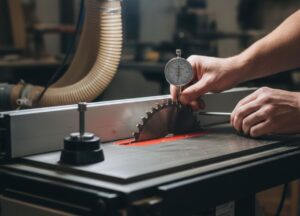
The next step is checking parallelism between the blade and the miter slot. A dial indicator mounted on a miter gauge delivers the best results, though feeler gauges or an accurate combination square can work when precision expectations are moderate. The goal is checking the distance from the slot to the same tooth at the front of the blade, then rotating that tooth to the rear and measuring again. A perfectly aligned saw produces equal readings. A small variation is acceptable, but anything more than a few thousandths of an inch begins to affect performance. Woodworkers may accept a slightly looser tolerance than metal fabricators, yet both benefit from accuracy.
Fence alignment also plays a role because the fence guides the workpiece along the blade. A fence that toes in toward the blade at the rear can trap the material and cause burning or binding. A fence that toes out can lead to wandering cuts and chatter. Some operators intentionally set a slight toe-out to reduce friction against the blade plate, though modern saws with rigid fences and smooth feed surfaces usually do best with a true parallel setting.
Common Causes of Misalignment
Shifting components are one of the most common reasons alignment drifts over time. Vibration can loosen trunnion bolts or table mounting points. Trunnions support the arbor assembly, so even a slight shift changes the blade path. A saw placed on an uneven floor or a mobile base may distort the table casting enough to affect accuracy. Temperature swings can move components as well, especially when shops shift from cool mornings to warm afternoons.
Blade changes also play a role. Some blades have plates that vary slightly in stiffness. If the arbor flange or washer is worn or dirty, the blade may not seat perfectly. That tiny tilt becomes noticeable once the blade spins at full speed. Arbor bearings that begin to wear can add runout, which feels similar to misalignment even though the cause is rotational wobble rather than skew.
Hard use in an industrial environment sometimes puts stress on the table or fence system. Heavy sheet goods placed abruptly on the cast iron surface may shift the table-to-trunnion relationship. The fence rail may flex if struck or if clamps are overtightened. Many shops check alignment after any accidental impact or after moving the machine to a new workstation.
Steps to Correct Blade Alignment
Correcting alignment is a patient process. The adjustments are usually small but require careful sequencing. Most contractors and fabricators start by loosening the trunnion bolts just enough to allow controlled movement, not enough to let the assembly slide freely. Light tapping with a rubber mallet helps guide the trunnions into position. Some cabinet saws adjust from the table instead, shifting the table casting over the stationary trunnion assembly. Your saw design determines the approach.
Accurate tools help, and this is where machinist squares, dial indicators, and precision straightedges prove valuable. Consistency matters more than brand. Once the blade is made parallel to the miter slot, attention shifts to the fence. Fence rails usually include adjustment points that allow small lateral or rotational changes. A straightedge placed along the fence face can help detect tiny deviations. Experienced technicians check the fence at both the front and the rear to make sure the entire length stays true.
Operators often forget about the splitter or riving knife during alignment. A riving knife that does not line up with the blade causes the workpiece to shift after it passes the cut. This misalignment can negate all the work done on blade geometry. A properly aligned riving knife sits directly behind the blade plate and follows the same path. Some saws include micro adjustments for this component while others rely on shimming.
Fine Tuning for Specialty Cuts
Certain cutting tasks benefit from tuning beyond basic alignment. Joinery cuts like dovetails or box joints require crisp, predictable kerfs. Cabinetmakers who run dado sets need flat bottom cuts with minimal vibration. A slight misalignment may not pose safety risks but can produce gaps in joinery that weaken the finished piece. Fabricators cutting aluminum plate or composite panels watch for edge chipping, which often improves when alignment is dialed in carefully.
Zero clearance inserts also respond to alignment adjustments. A blade that leans slightly will wear one side of the insert opening more than the other. A well aligned saw distributes the cut through the center of the insert, improving dust collection and reducing tearout in panel materials.
Shops working with abrasive composites or mineral filled panels often notice blade deflection during long cuts. Alignment helps mitigate this by ensuring the material feeds without side pressure. Proper feed technique, matched blade type, and controlled cutting speed support that stability. Operators may also check arbor torque because an under-tightened arbor nut can increase the chance of plate movement under load.
Signs That Indicate Alignment Problems
Several telltale symptoms reveal when a saw needs adjustment. Burn marks on one side of the cut usually point to the blade contacting the material near the rear of the rotation. An unusual whining pitch during feed often comes from rubbing rather than cutting. Slight hesitation or resistance when pushing the workpiece forward can suggest side pressure caused by skew.
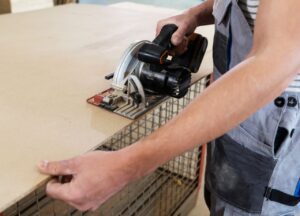
Material that kicks out or shifts suddenly during ripping signals that the blade path and fence path do not match. Technicians often run a long board through the saw while listening and watching for wobble or drift. If the board tries to move away from the fence or presses against it harder as it moves, alignment is likely off.
Operators who track blade life may notice premature dulling on one side of the carbide tips. This asymmetrical wear indicates that the blade is not entering the material squarely. Even the cleanest, sharpest blade will struggle when misalignment forces the plate to act as a friction surface.
Preventative Maintenance for Long Term Accuracy
Regular checks help keep a table saw performing at its best. Many shops schedule alignment inspections during routine machine maintenance. Daily cleaning prevents dust and debris from interfering with measurements. Periodic lubrication of elevation and tilt mechanisms keeps them responsive and prevents binding that can throw alignment out of balance.
A stable base is another part of preventative care. A saw placed on an uneven surface twists slightly, which shifts internal geometry. Leveling the base and checking caster locks on mobile units protects accuracy. Some shops anchor cabinet saws to the floor when heavy production work requires reliable repeatability.
Blade storage also influences alignment indirectly. A blade with resin buildup or corrosion may not seat perfectly against the arbor flange. Cleaning blades regularly and inspecting flanges for nicks ensures that each blade installs with a true, flush fit. Arbor bearings should be checked during extended maintenance intervals to ensure they rotate smoothly without side play.
Maintaining Accuracy Creates Better Results
Consistent alignment brings predictable cutting performance, safer operation, and less strain on the machine. Production teams see faster throughput because fewer cuts need rework. Craftsmen achieve cleaner joints and smoother surfaces. Technicians appreciate that a properly aligned machine responds better to calibration and holds its settings longer.
Table saws remain vital in woodworking and fabrication shops. Alignment is not a one time task but an essential practice that protects both workers and equipment. A well maintained saw encourages confidence during operation and supports quality across every project that moves across the table.